Handing a car down to a son, a daughter or a parent is one of the most common vehicle transfers in BC, and one of the most confusing. Done right, it costs nothing in tax. Done wrong, the new owner can get a PST bill months later, plus penalty and interest.
This guide covers who counts as family for the PST gift exemption, the two forms you need, the situations that turn a "gift" into a taxable sale, and what happens at the Autoplan broker. It sits alongside my main guide to the ICBC transfer form (APV9T), which covers regular private sales.
In BC you can gift a car to a close family member without paying PST. The person giving the car and the person receiving it both sign the Gift of a Vehicle form (FIN 319) and the ICBC Transfer/Tax Form (APV9T), then the new owner registers and insures it at an Autoplan broker. The exemption only covers related individuals such as a spouse, parent, child, grandparent, grandchild or sibling, and only when nothing is paid for the car, including taking over a loan.
Is gifting a car to family tax-free in BC?
It can be. BC's Provincial Sales Tax Act exempts a vehicle given as a gift between related individuals, as long as three things are true: the person receiving it pays nothing for it, the person giving it originally paid the applicable tax on it, and the paperwork is completed in full at registration. If any of those fail, PST is charged on the vehicle's fair market value, not on the zero dollars written on a gift.
Who counts as family for the PST gift exemption?
"Family" for PST purposes is narrower than most people expect. Spouses, parents, children, grandparents, grandchildren and siblings qualify. In-laws mostly don't, with two exceptions: your child's spouse, and your spouse's parents, grandparents and children.
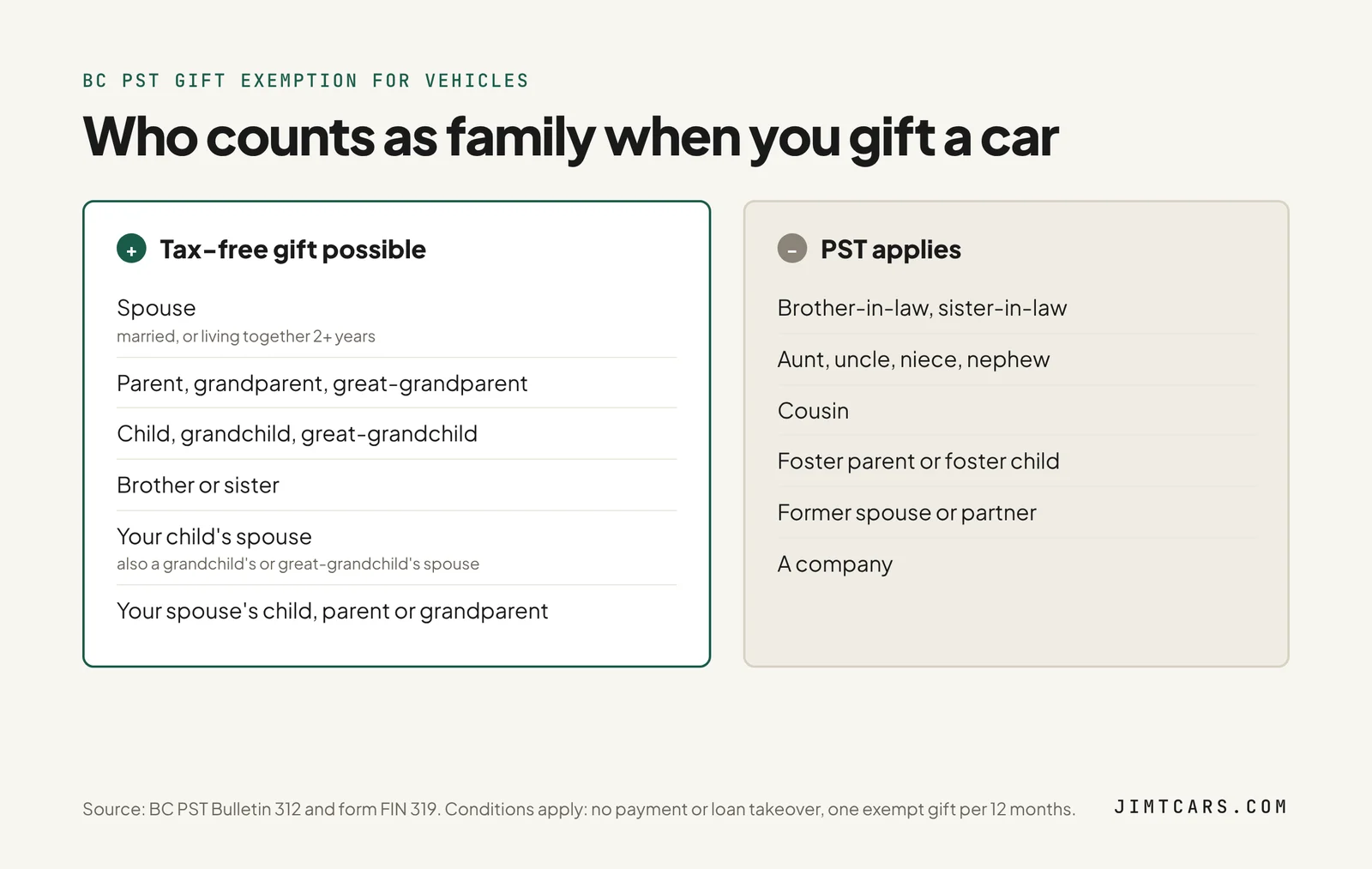
- Qualifies: a spouse (married, or living together in a marriage-like relationship for at least 2 years), child, grandchild, great-grandchild, parent, grandparent, great-grandparent or sibling. Also the spouse of your child, grandchild or great-grandchild, and the child, parent, grandparent or great-grandparent of your spouse.
- Doesn't qualify: a brother-in-law or sister-in-law, aunt or uncle, niece or nephew, cousin, foster parent or foster child, a former spouse or partner, or a company.
When a "gift" is not a gift
This is where most people get caught. The exemption only works for a true gift, and the rules are specific:
- Taking over a loan makes it a sale. If you take over the payments on a car that still has a loan, PST is payable on the outstanding loan amount.
- Any payment makes it a sale. Even a token amount, or a trade for something else, means it isn't a gift.
- One exempt gift per vehicle per 12 months. A car can't be passed tax-free from person to person in a chain. The donor generally cannot give away a car they received as an exempt gift in the last 12 months, unless it goes back to the person who gave it to them.
- The donor must have paid the tax. A car originally bought in a GST-only province such as Alberta, or gifted from outside Canada, generally doesn't qualify.
Calling a sale a gift to avoid PST isn't a grey area. The Ministry of Finance can assess the recipient for the tax plus penalty and interest, and false information on the form can bring fines.
How to gift a car in BC, step by step
- Fill in the Gift of a Vehicle form (FIN 319). Both the donor and the recipient sign it, at or before the transfer. It's often called the "ICBC gift letter", but it's a Ministry of Finance form.
- Complete the ICBC Transfer/Tax Form (APV9T). Both of you fill in and sign your sections, with original signatures on all four pages, exactly as in a regular sale.
- Sign over the registration. The donor signs the vehicle registration and gives it to the recipient.
- Plates and insurance. In BC the plates belong to the owner, not the car. The donor takes their plates off and cancels or transfers their insurance.
- Register and insure at an Autoplan broker. The recipient brings the FIN 319, the APV9T, the signed registration and ID, gets plates and insurance in their own name, and should do it within the same 10-day window as any purchase. The broker can only process the transfer as tax-exempt if the FIN 319 is complete.
- Keep the paperwork. Hold on to your copy of the FIN 319 for five years in case the ministry asks.
Helping a son or daughter find their first car instead? I find a reliable used car anywhere in Canada, have it inspected in person and negotiate the price.
Car Finding Service, $790What if the gift does not qualify?
Then the transfer is taxed like a private sale. PST is charged on the vehicle's fair market value at the private-sale rates (12% for most cars, higher for vehicles over $125,000), and the Autoplan broker collects it when the new owner registers the car. The full rate table is in my ICBC transfer form guide. If you're buying the car from a relative rather than receiving it as a gift, the same applies: it's a sale, priced and taxed like one.
Gifting a car that came from another province
If the car was registered outside BC, the recipient needs the same gift paperwork plus proof that tax was paid on the vehicle, and the car will need the usual out-of-province inspection before it can be registered in BC. As noted above, a car first bought in Alberta usually doesn't qualify for the exemption. My guide to buying a used car in another province covers the inspection and registration side.
Is a hand-me-down car actually a good deal?
Often yes, but not always. A free car with a failing transmission or a rusted subframe can cost more in its first year than a reliable one you pay for. If the car is old, high-kilometre or coming from far away, have it looked over before the paperwork. My team does that in person anywhere in Canada.
Not sure the family car is worth keeping? My team inspects it in person in any province: photos, video, Carfax with a lien check and a written verdict on whether it's worth registering.
Book an inspection, $490 →Frequently asked questions
Do I pay PST if my parent gives me a car in BC?
No, as long as it is a true gift. A gift from a parent to a child qualifies for the PST exemption when nothing is paid in return and both of you complete the Gift of a Vehicle form (FIN 319) for the Autoplan broker.
What is the ICBC gift letter?
People usually mean the Gift of a Vehicle form, FIN 319. It is a BC Ministry of Finance form, not an ICBC form, that both the donor and the recipient sign so the Autoplan broker can register the transfer without PST.
Can I gift a car to my brother-in-law tax-free?
No. Brothers-in-law and sisters-in-law are not related individuals for the PST gift exemption, so PST applies on the fair market value. The same goes for aunts, uncles, nieces, nephews, cousins and former spouses.
What if my parent still owes money on the car?
If you take over the loan, it is not a gift. PST is payable on the outstanding loan amount. A gift only qualifies when no payment or loan takeover is given in exchange.
Do we need a notary for the FIN 319 gift form?
Not usually. Both people sign the form at or before registration. A notarized statement is only needed in a narrow case involving an out-of-province vehicle that was received as a gift in BC before April 2013.
Can a car gifted from Alberta be PST-free in BC?
Usually not. A vehicle that was originally bought in a GST-only province, such as Alberta, generally does not qualify for the gift exemption, because no PST or HST was paid on it. Expect to pay PST when you register it in BC.
Sources: BC Ministry of Finance, Gift of a Vehicle form FIN 319; BC PST Bulletin 312, Gifts; ICBC, sell a used vehicle. This guide is general information, not tax or legal advice. Confirm your situation with an Autoplan broker or the Ministry of Finance.