Ontario has the best paperwork in the country for private car sales, and most buyers never read it. The province makes the seller hand you a package with the car's owner history, odometer readings, lien status and its tax value. It's called the UVIP, it costs the seller $20, and it answers half the questions you were going to ask anyway.
This guide walks through a private purchase in Ontario from first message to plates on the car: the UVIP, the safety certificate, the 13% tax and the wholesale value trap, the 6-day deadline, and the checks that keep you away from curbsiders and rust buckets.
To buy a used car privately in Ontario, get the Used Vehicle Information Package (UVIP) from the seller, check it for liens and the wholesale value, sign a bill of sale and the transfer section of the ownership permit, then register the car at ServiceOntario within 6 days. You pay 13% RST there on the purchase price or the Red Book wholesale value, whichever is higher. To put plates on it you also need a Safety Standards Certificate, which is valid for 36 days.
In this guide
- The Ontario private sale in 6 steps
- What is the UVIP and how to read it
- Safety Standards Certificate: what it is and what it is not
- The 13% tax and the wholesale value trap
- Registering at ServiceOntario within 6 days
- Red flags in Ontario private sales
- Rust: the Ontario tax nobody mentions
- Dealer or private: which is safer in Ontario?
- Frequently asked questions
The Ontario private sale in 6 steps
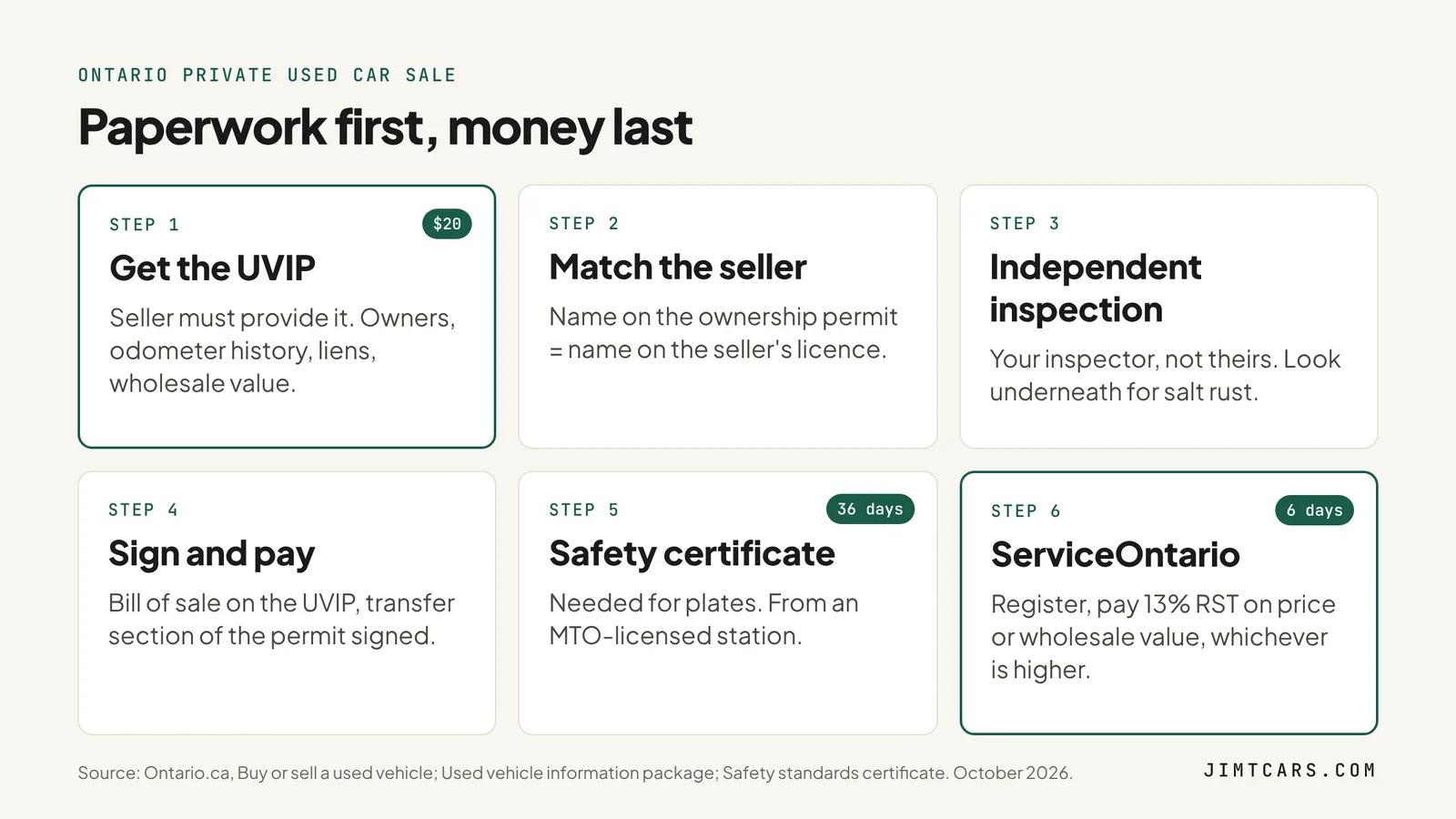
- Ask for the UVIP before you drive anywhere. A real private seller has one or can get one. Read it before you look at the car (more on what to read below).
- Match the seller to the paperwork. The name on the ownership permit must match the seller's driver's licence. Not a cousin, not "my buddy's car".
- Get the car inspected by someone who works for you. Not the seller's mechanic. A Safety Standards Certificate isn't a pre-purchase inspection (I explain why below).
- Sign the bill of sale and the ownership permit. The bill of sale is the section at the bottom of the UVIP: date, price, VIN, both names and addresses, both signatures. The seller completes the transfer section on the back of the permit.
- Get the Safety Standards Certificate if the seller hasn't, and insure the car in your name.
- Register at ServiceOntario within 6 days and pay the 13% RST there. Plates stay with the seller, so you get your own.
What is the UVIP and how to read it
The Used Vehicle Information Package is a document from ServiceOntario that the seller must give you in a private sale. It costs $20, can be ordered online with the VIN or plate number and arrives by mail, or comes the same day at any ServiceOntario centre. Here's what is inside and what I look at first:
- Ontario registration history. Every owner, the city they lived in, and the odometer reading at each transfer. Four owners in two years is a flipped car. Kilometres that go down between owners is a rolled odometer, and that ends the conversation.
- Lien information. Whether a lender has a registered claim on the car. A lien claimant can take the car, or the money owed, from you after the transfer. Yes, from you.
- Wholesale value. The Red Book average for that year, make and model. This is the minimum value the 13% tax is charged on.
- Condition status. Whether the car is registered as unfit, rebuilt or reported as wrecked.
- Bill of sale section at the bottom, which you fill in together.
The UVIP isn't required when the car comes from a registered dealer, when it's a transfer between family members, or when the car was bought or sold outside Ontario. Pay attention to that last one: a car brought in from Alberta or BC has no Ontario history to report, so you'll need a Carfax with a national lien search instead.
Safety Standards Certificate: what it is and what it is not
You need a Safety Standards Certificate to put plates on a used car you bought, unless it came from your spouse. It is issued by any MTO-licensed inspection station (look for the Ontario DriveON sign), it's valid for 36 days, and the price is set by the shop, not the government.
Plenty of private cars are sold "as is", which means without a certificate. That is legal. It also means you pay for the certificate and for whatever the car needs to pass, and you cannot drive it on plates until it does.
The 13% tax and the wholesale value trap
You don't pay tax to the seller. You pay 13% retail sales tax at ServiceOntario when you register the car. The tax is calculated on the purchase price or the wholesale value printed in the UVIP, whichever is higher.
| You paid | UVIP wholesale value | Tax is charged on | RST at 13% |
|---|---|---|---|
| $12,000 | $10,500 | $12,000 (your price) | $1,560 |
| $9,000 | $10,500 | $10,500 (wholesale) | $1,365 |
| $9,000, with an appraisal at $8,800 | $10,500 | $9,000 (the higher of price and appraisal) | $1,170 |
If you really did pay less than the wholesale value, because the car needs work or has high kilometres, you can get an appraisal from a licensed dealer or appraiser and the tax is then based on the higher of your price and the appraised value. Cars 20 years or older always need an appraisal.
Two exemptions are good to know. A car given as a gift to a close family member is tax-free with the Sworn Statement for a Family Gift of a Used Motor Vehicle, available at ServiceOntario. And if you're bringing in a car you bought in another province, the rules depend on what tax you already paid; my guide to buying a used car in another province covers that case.
Registering at ServiceOntario within 6 days
You have 6 days from the purchase to register the car in your name. Bring:
- Proof of insurance in your name
- Your Ontario driver's licence
- The UVIP, original and undamaged, with the tear-off stub still attached
- The signed bill of sale
- The ownership permit with the transfer section completed by the seller
- The Safety Standards Certificate, if you want plates now, and the odometer reading
The seller keeps the plates, so you either move your own plates over or get new ones. Fees vary by vehicle class and location, so check with ServiceOntario before you go.
Red flags in Ontario private sales
Ontario has a curbsider problem: unlicensed dealers posing as private sellers, often with write-offs and rolled odometers. OMVIC, the dealer regulator, can't help you after a private sale, because private sales are outside its rules. Walk away if:
- The seller isn't the person on the ownership. Or the car was registered to them a few weeks ago.
- The seller has several cars listed or drives up on a yellow mechanic's plate or a dealer plate.
- There is no UVIP, or the seller talks you out of buying a Carfax.
- They refuse an independent inspection. OMVIC's advice here's short: if the seller resists, walk away. I agree, and I'd walk faster.
- The price is far below similar cars. In Ontario, a deal that looks too good usually comes with a story.
I cover the scams in detail, including deposit scams and fake history reports, in my guide to used car scams in Canada.
Rust: the Ontario tax nobody mentions
Ontario puts a lot of salt on its roads, and salt eats cars from the bottom up. A car that looks clean from the driveway can have rotten brake lines, a rusted subframe or rocker panels held together by undercoating and optimism. On any Ontario car, look underneath with a flashlight: brake and fuel lines, subframe mounts, rocker panels, rear wheel arches and the bottom of the doors. Yearly rust-proofing records are a good sign. Fresh black undercoating on an old car can be a good sign, or a cover-up.
Found a car in Toronto, Ottawa or Thunder Bay you can't see yourself? My team inspects it in person anywhere in Ontario before you pay.
Remote inspection, $490Dealer or private: which is safer in Ontario?
A private sale is cheaper on the sticker, and you pay the same 13% either way. What you give up is protection. An OMVIC-registered dealer has to disclose a car's history in writing, has to advertise all-in prices, and is backed by a compensation fund. A private seller owes you the UVIP and honesty, and only one of those is enforced. If you buy privately, the UVIP, a lien check and an independent inspection are the protection. Skip them and you're betting your money on a stranger's memory. My guide to dealer fees in Alberta and Ontario covers what a dealer is allowed to add to the price.
Buying privately somewhere in Ontario? My team checks the car in person: photos, video, a road test, Carfax with a national lien check and a written verdict. You decide with facts, not with the seller’s story.
Book an inspection, $490 →Frequently asked questions
Who pays for the UVIP in Ontario, the buyer or the seller?
The seller. Under the Highway Traffic Act the seller must give the buyer a Used Vehicle Information Package in a private sale. It costs $20 from ServiceOntario. A buyer can also order one before the sale to check the car.
Can I buy a car in Ontario without a safety certificate?
Yes. You can buy and register a car without a Safety Standards Certificate, but you cannot put plates on it and drive it until it passes. Cars sold this way are usually advertised as "as is", and the cost of any repairs needed to pass is yours.
How long is an Ontario safety certificate valid?
36 calendar days from the inspection. If you do not register the car within that window, you have to pay for a new inspection and certificate.
How much tax do I pay on a private used car sale in Ontario?
Most buyers pay 13% retail sales tax at ServiceOntario. It is charged on the purchase price or the wholesale value in the UVIP, whichever is higher. If you paid less than the wholesale value, you can get an appraisal, and vehicles 20 years or older always need one.
How many days do I have to register a used car in Ontario?
Six days from the purchase. Bring proof of insurance, your Ontario driver's licence, the UVIP, the bill of sale, the ownership permit with the transfer section completed, and the Safety Standards Certificate if you are plating the car.
Is a family gift taxed in Ontario?
A car given as a gift to a close family member is exempt from RST. The giver and the receiver complete the Sworn Statement for a Family Gift of a Used Motor Vehicle at ServiceOntario. A UVIP is also not required for transfers between family members.
Does the UVIP show if a car has a lien?
Yes, it includes lien information from Ontario's personal property registry as of the date it was printed. A lien registered after that date will not show, and a lien registered in another province will not show at all, so check the date and run a national search if the car came from outside Ontario.

Written by Jim T. (Jim Troian)
Car consultant. I started on the floor of BC dealerships, so I know both sides of the desk. Now I help buyers anywhere in Canada find, check and negotiate used cars, with an inspection team in every province. More about me.
Sources: Ontario.ca, Buy or sell a used vehicle in Ontario; Ontario.ca, Used vehicle information package; Ontario.ca, Safety standards certificate; OMVIC, Avoid curbsiders. Rules checked October 2026. This guide is general information, not legal or tax advice; confirm fees and your situation with ServiceOntario.