Here's a fun fact about the Canadian used car market: the cheapest cars in the country are all located on oil rigs, on military deployments and in shipping company warehouses. Their owners are always in a hurry, always far away, and always fine with a deposit by e-Transfer.
Scams around used cars aren't new, but in 2026 they look better than ever. Listings are copied from real dealers, messages are polished, and some scammers now hand you a history report they made themselves. Below are the nine red flags I see most, what each scam looks like in practice, and the one thing to do about each.
The most common used car scams in Canada in 2026 are fake listings that ask for a deposit, curbsiders posing as private sellers, rolled-back odometers backed by fake history reports, cars sold with an unpaid loan, and stolen or VIN-cloned cars. You avoid nearly all of them with four habits: never pay before you have seen the car and the seller's ID, buy the history report yourself, match the VIN in three places, and get an independent inspection. If a seller resists any of those, walk away.
In this guide
9 red flags, at a glance
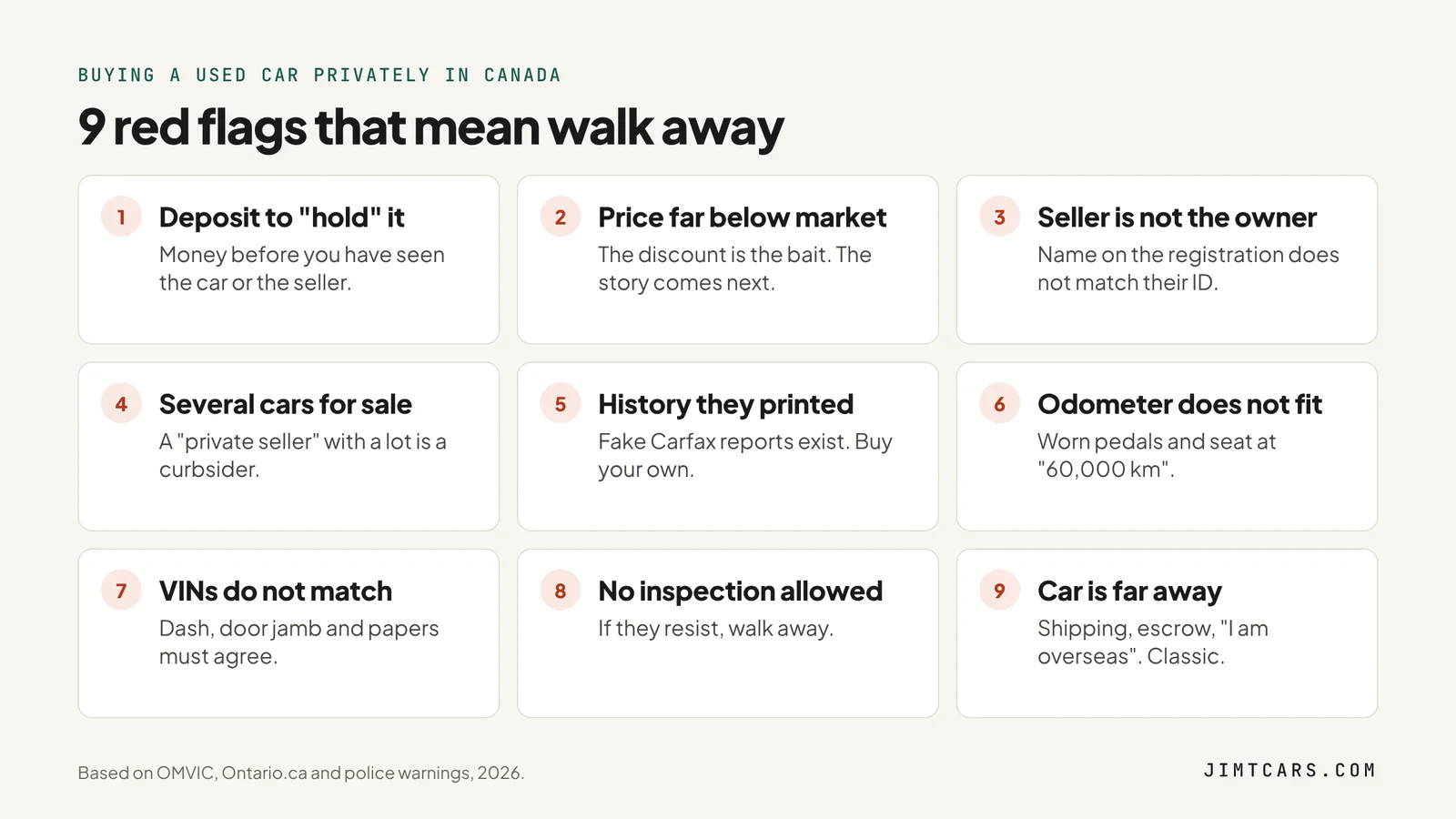
The red flags, one by one
A deposit to "hold" the car
This is the big one in 2026. OMVIC warned in July that scammers are copying real dealer listings, using real salespeople’s names, and pushing buyers to send a deposit before someone else grabs the car. Facebook Marketplace is where it happens most. The moment the money lands, the chat goes quiet.
Do this: Never pay anything before you have seen the car and the seller in person, or before someone you trust has. If the ad claims to be a dealer, call the dealer using the number on its official website, not the one in the ad.
A price far below every similar car
A 2019 RAV4 Hybrid for $14,000 isn't a lucky find. Under-priced listings exist to get you emotional and in a hurry. The story comes next: divorce, moving overseas, "my late father’s car".
Do this: Check the price against real market numbers. My model guides show average Canadian asking prices by year. More than 20% under the average needs a very good reason.
The seller is not the owner
The name on the registration doesn't match the person in front of you. "It's my brother’s car." "I bought it last month, didn't transfer it yet." Maybe. Also maybe stolen, maybe a curbsider, maybe a car with a loan the real owner doesn't know about.
Do this: Ask to see the seller’s driver’s licence and the registration side by side. Write the licence number on the bill of sale, as Edmonton police advise. No match, no deal.
Several cars for sale
A "private seller" with four cars listed and a different one in the driveway each week is a curbsider: an unlicensed dealer avoiding the rules that protect you. OMVIC says many curbsided cars are previous write-offs with undisclosed repairs. Buying from one gets you none of the protection a registered dealer gives.
Do this: Search the seller’s phone number and profile name. Several listings or a yellow mechanic’s plate on their own car means walk away.
A history report the seller printed
In April 2026 Edmonton police charged a man who allegedly bought high-kilometre Altimas, Accords and CR-Vs on Marketplace, rolled the odometers back by hundreds of thousands of kilometres, and resold them with falsified Carfax reports. The reports looked real. That was the point.
Do this: Buy the report yourself, with the VIN you read off the car. It costs less than one payment on a bad car.
An odometer that does not fit the car
Digital odometers can be rolled back too. The car tells on itself, though: a shiny steering wheel, worn pedal rubber, a sagging driver’s seat and a cracked key fob at "62,000 km" don't add up.
Do this: Compare the reading with the service records, the history report and old inspection stickers. If the kilometres go down at any point, end the conversation.
VINs that do not match
The VIN appears on the dashboard (through the windshield), on the driver’s door jamb and on the registration. Stolen cars sometimes get a cloned VIN from a legit car of the same model. Ontario warns that stolen cars often show errors in their history, such as the wrong colour or odometer readings.
Do this: Read all three VINs yourself. Check the history report says the same colour and model. Never register a car in your name "as a favour" for someone else.
No independent inspection allowed
"My mechanic already checked it." "No time, I have three people coming." A seller with nothing to hide wants the inspection, because it sells the car for them.
Do this: Make the sale conditional on an inspection by someone who works for you. OMVIC’s advice is: if the seller resists, walk away. Mine is the same, at a brisk pace.
The car is far away
The classic: the car sits with a "shipping company" or "escrow service", the seller is overseas, and you just need to pay the shipping company first. The shipping company is the scammer, with a nice website.
Do this: Never pay a third party you found through the seller. If the car really is in another city, have it inspected in person before any money moves.
Two more checks that catch what the flags miss
Liens. In a private sale, an unpaid car loan stays with the car and can follow you after you pay. The seller may not even mention it. My guide to checking for liens in Canada covers where to search in every province.
Brands and damage. A rebuilt, salvage or flood car isn't always a scam, but hiding it is. The history report shows the status and where the car has lived. A car that came from the US or moved between provinces often has the most interesting history, and sometimes the least visible one.
How to pay safely for a used car
- No money before the car, the seller's ID and the VIN all check out. Not a deposit, not a "small holding fee".
- Meet at the seller's bank or yours. A bank draft bought in front of the seller, or a transfer done at the branch, protects both of you.
- Cash means a written, signed bill of sale with both names, addresses, the VIN, date and price.
- If there's a loan on the car, pay the lender directly and get the release letter.
If you already got scammed
Move fast. Call your bank about the payment the same day, report it to the police and to the Canadian Anti-Fraud Centre, and report the listing to the platform. Screenshot every message and the ad before they disappear. If the seller was a curbsider in Ontario, report them to OMVIC too; it investigates illegal sellers even though it can't cover a private purchase.
Found a car online in another city? My team goes and looks at it in person, anywhere in Canada, before you send a cent.
Remote inspection, $490Buying in Ontario? See my guide to buying a used car privately in Ontario. In BC, start with how to buy a used car in Vancouver.
Do not want to play detective? With my Car Finding Service I find the car, have it inspected, check the history and liens, and negotiate the price. You get the keys, not the stories.
Car Finding Service, $790 →Frequently asked questions
What is the most common used car scam in Canada?
Fake listings that ask for a deposit. Scammers copy real dealer or private ads, often on Facebook Marketplace, pressure you to send a deposit to hold the car, and disappear once the money arrives. OMVIC warned about this pattern in July 2026.
What is a curbsider?
An unlicensed dealer who poses as a private seller to avoid dealer rules. Curbsiders often sell write-offs with undisclosed repairs or rolled-back odometers. Warning signs include several cars for sale, a car not registered in the seller's name, and refusal of an independent inspection.
Can a Carfax report be faked?
Yes. In April 2026 Edmonton police charged a seller who allegedly gave Marketplace buyers falsified Carfax reports to hide odometers rolled back by hundreds of thousands of kilometres. Always order the report yourself with the VIN from the car.
Is it safe to send an e-Transfer deposit for a used car?
Not before you have seen the car, checked the seller's ID against the registration and confirmed the VIN. An e-Transfer cannot be reversed once it is accepted. If you must hold a car remotely, have someone inspect it in person first.
How do I check if a used car is stolen in Canada?
Match the VIN on the dashboard, the driver's door jamb and the registration. Make sure the seller's ID matches the registered owner. A Carfax Canada report flags vehicles reported stolen, and in BC the ICBC claims history report shows if a car was possibly reported stolen.
What should I do if I was scammed buying a car?
Report it to your local police and to the Canadian Anti-Fraud Centre, contact your bank right away about the payment, and report the listing to the platform. If the seller was a curbsider in Ontario, also tell OMVIC.

Written by Jim T. (Jim Troian)
Car consultant. I started on the floor of BC dealerships, so I know both sides of the desk. Now I help buyers anywhere in Canada find, check and negotiate used cars, with an inspection team in every province. More about me.
Sources: OMVIC, Fake ads: how scammers fool car buyers (July 2026); OMVIC, Avoid curbsiders; Edmonton Police Service, odometer fraud charges (April 2026); Ontario.ca, Buy or sell a used vehicle. Charges mentioned haven't been proven in court.