A lien is the lender's way of saying "we still own a piece of this car." Buy that car privately without checking, and you can end up paying for it twice: once to the seller, and once to the bank that comes to collect it. It takes ten minutes and about the price of a pizza to avoid. Most people still skip it.
This guide shows how to check a used car for liens in every part of Canada, why one provincial search is often not enough, and how to buy a car with a lien on it without losing your money.
Check for a lien with the VIN before you pay. In Ontario, the seller's UVIP ($20) shows Ontario liens. In BC, search the Personal Property Registry ($7 online, $10 with staff). In Alberta, ask any registry agent for a serial number search. A provincial search only covers liens registered in that province, so for a car that has lived in more than one province, a Carfax Canada report with the national lien check (about $98 plus GST in BC) is the simplest option. If there's a lien, the seller pays it off and gives you a lien release letter before any money changes hands.
In this guide
What a lien is and why it is your problem
When someone finances or leases a car, or borrows against it, the lender registers its claim in the province's personal property registry. That registration is the lien. It's attached to the car, not to the person. So when the car changes hands in a private sale, the debt goes with it.
Carfax Canada's advice for a car with a lien is simple enough: the current owner pays it off and gets a lien release letter before the sale. If the seller disappears instead, your options are legal action or paying off someone else's loan to keep a car you already paid for. Neither makes for a good afternoon.
Where to check for a lien, province by province
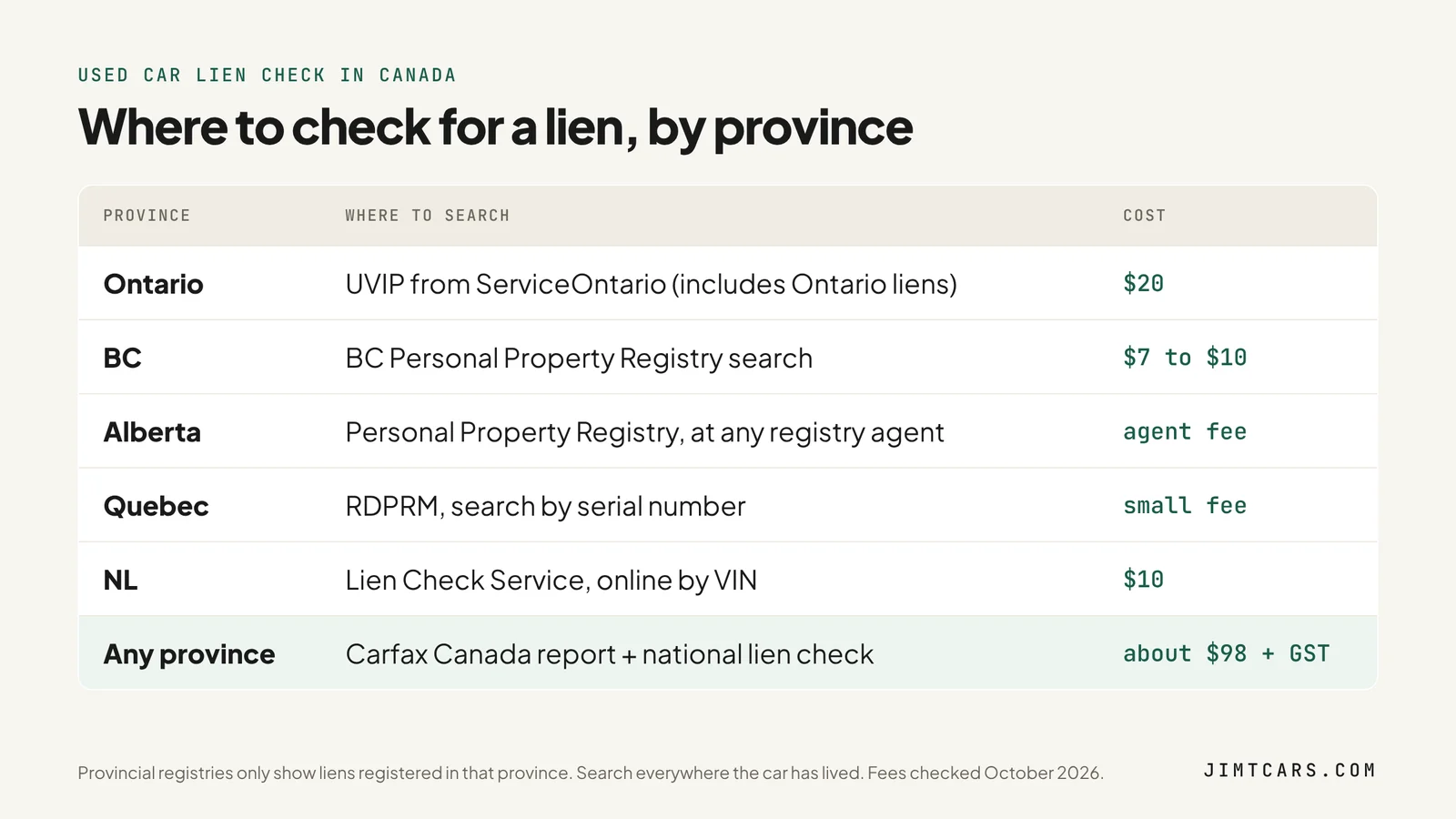
| Province | Where to search | What it costs |
|---|---|---|
| Ontario | The UVIP from ServiceOntario includes Ontario lien information. The seller must give it to you; you can also order your own online with the VIN or plate. | $20 |
| BC | BC Personal Property Registry search through BC Registries, by serial number (VIN). ICBC’s claims history report doesn't include liens. | $7 online, $10 with staff |
| Alberta | Personal Property Registry serial number search at any registry agent (form REG3345). | Set by the agent |
| Saskatchewan, Manitoba | The province’s Personal Property Registry, searched by serial number. | Small registry fee |
| Quebec | RDPRM (Register of personal and movable real rights), consultation by serial number. | Small registry fee |
| Newfoundland and Labrador | Lien Check Service, online by VIN, part of the Atlantic provinces’ shared registry system. | $10 |
| Any province | Carfax Canada report with the lien check, which searches every province and territory where the car has been registered (except the NWT). | About $98 + GST in BC |
The mistake: searching only one province
Provincial registries only know about their own province. A car financed in Calgary and driven to Vancouver can show "no match" in BC and still carry a full loan in Alberta. Cars move around Canada more than people think, especially the ones that are cheap for a reason.
So the rule is simple: search every province the car has lived in. The registration history in a Carfax, a UVIP or an Alberta vehicle information report tells you where that is. If the car has lived in more than one province, the national lien check is worth the money.
Timing matters: search on the day you pay
A lien search is a snapshot. A search from last month says nothing about the loan the seller took out last week. Ontario's UVIP shows liens as of the date it was printed, so check that date. My rule: run the search, or get a fresh report, on the day the money moves. Then keep a copy with your bill of sale.
Buying a car that has a lien: the safe way
A lien isn't automatically a deal-breaker. Plenty of decent people sell cars they're still paying for. What you need is the loan paid out before the car is yours.
- Get the payout amount in writing from the lender, dated, with the account details.
- Pay the lender directly, or meet the seller at their bank and watch the loan get paid. If your price is higher than the payout, the difference goes to the seller.
- Get the lien release letter (also called a discharge) from the lender before you register the car.
- Search again after the discharge is registered, to confirm the lien is gone.
A lien check is not a history check
A clean lien search tells you the car is free of debt. It tells you nothing about accidents, rolled odometers, flood damage or a rebuilt status. For that you need the history report and, on anything you're serious about, an inspection by someone who works for you. If the seller hands you a history report they printed themselves, buy your own. In 2026 Edmonton police charged a Marketplace seller with handing buyers falsified Carfax reports to hide odometers rolled back by hundreds of thousands of kilometres. More on that in my guide to used car scams in Canada.
Want someone else to do all of this? Every inspection includes a Carfax with the national lien check, photos, video and a written verdict.
Remote inspection, $490Liens and dealers
When you buy from a registered dealer, clearing any lien on the car is part of what the dealer does before the sale, and your purchase agreement should say the car is free of liens. When you trade in a car that still has a loan, the dealer pays it out and adds or subtracts the balance on your deal. Read that line on the paperwork carefully; my guide to dealer fees and financing in BC covers where the numbers hide.
Buying privately in Ontario? My step-by-step guide to buying a used car privately in Ontario covers the UVIP, safety and tax. In BC, the paperwork side is in the ICBC transfer form guide.
Buying a car in another province or city? My team checks it in person, runs the national lien search and tells you straight whether it is worth your money.
Book an inspection, $490 →Frequently asked questions
How do I check if a car has a lien in Canada?
Search the VIN in the personal property registry of each province where the car has been registered, or buy a Carfax Canada Vehicle History Report with the lien check, which searches every province and territory where the car has been registered except the Northwest Territories.
What happens if I buy a car with a lien on it?
In a private sale the lien stays with the car, not with the seller. The lender can claim the car, or the money owed, from you as the new owner. You would then have to recover your money from the seller yourself.
How do I check for a lien in Ontario?
The Used Vehicle Information Package (UVIP) that the seller must give you includes lien information from Ontario's registry. It costs $20 from ServiceOntario. Check the print date, because liens registered after that date will not appear.
How much is a lien search in BC?
A Personal Property Registry search costs $7 online through BC Registries, plus a small operator fee in some cases, or $10 when government staff do it for you. ICBC's $20 claims history report does not include a lien search.
Can I buy a car with a lien if the seller pays it off?
Yes, if you do it safely. The best way is to pay the lender directly, or meet the seller at their bank, so the loan is paid out in front of you. Do not register the car until you have the lien release letter from the lender.
Does a lien search show repair liens?
A registered repairer's or storage lien shows up in the provincial registry like any other lien. An unpaid repair bill that was never registered will not show, which is one more reason to ask for the service records.

Written by Jim T. (Jim Troian)
Car consultant. I started on the floor of BC dealerships, so I know both sides of the desk. Now I help buyers anywhere in Canada find, check and negotiate used cars, with an inspection team in every province. More about me.
Sources: Carfax Canada, What's a lien on a car; Ontario.ca, Used vehicle information package; BC Registries, Personal Property Registry fees; ICBC, Vehicle history reports; Alberta.ca, Find a personal property registration; Government of Newfoundland and Labrador, Lien Check Service. Fees checked October 2026. General information, not legal advice.